 KidCue
2026-06-23
When a 5-Year-Old Can’t Focus on Math, Start With Five Visible Minutes
If a younger sibling keeps distracting your 5-year-old during homeschool math, a five-minute visual timer can make focus feel possible instead of endless.
Sometimes the problem is not that a child refuses math.
Sometimes the problem is that focusing feels too big.
Especially when there is a little sibling nearby.
The younger child is talking.
Or singing.
Or dropping blocks.
Or climbing into the chair.
And the 5-year-old is supposed to ignore all of that and finish a math page.
That is hard.
Not “try harder” hard.
Actually hard.
For a young child, focus is still developing. It is not a switch they can flip because an adult says, “Pay attention.”
It is more like a muscle.
It gets stronger with short, repeatable practice.
Not with shame.
Not with lectures.
Not with a whole worksheet that feels like forever.
With one small window of success.

Why five minutes can work better than “finish this”
“Finish your math” can feel endless to a 5-year-old.
They do not always know:
- how long it will take
- when they can stop
- whether the sibling will interrupt again
- whether the adult will keep adding more
So the task becomes bigger than the page.
It becomes:
I have to sit here until someone decides I am done.
A visual timer changes the agreement.
Instead of:
“Focus until math is finished.”
You can say:
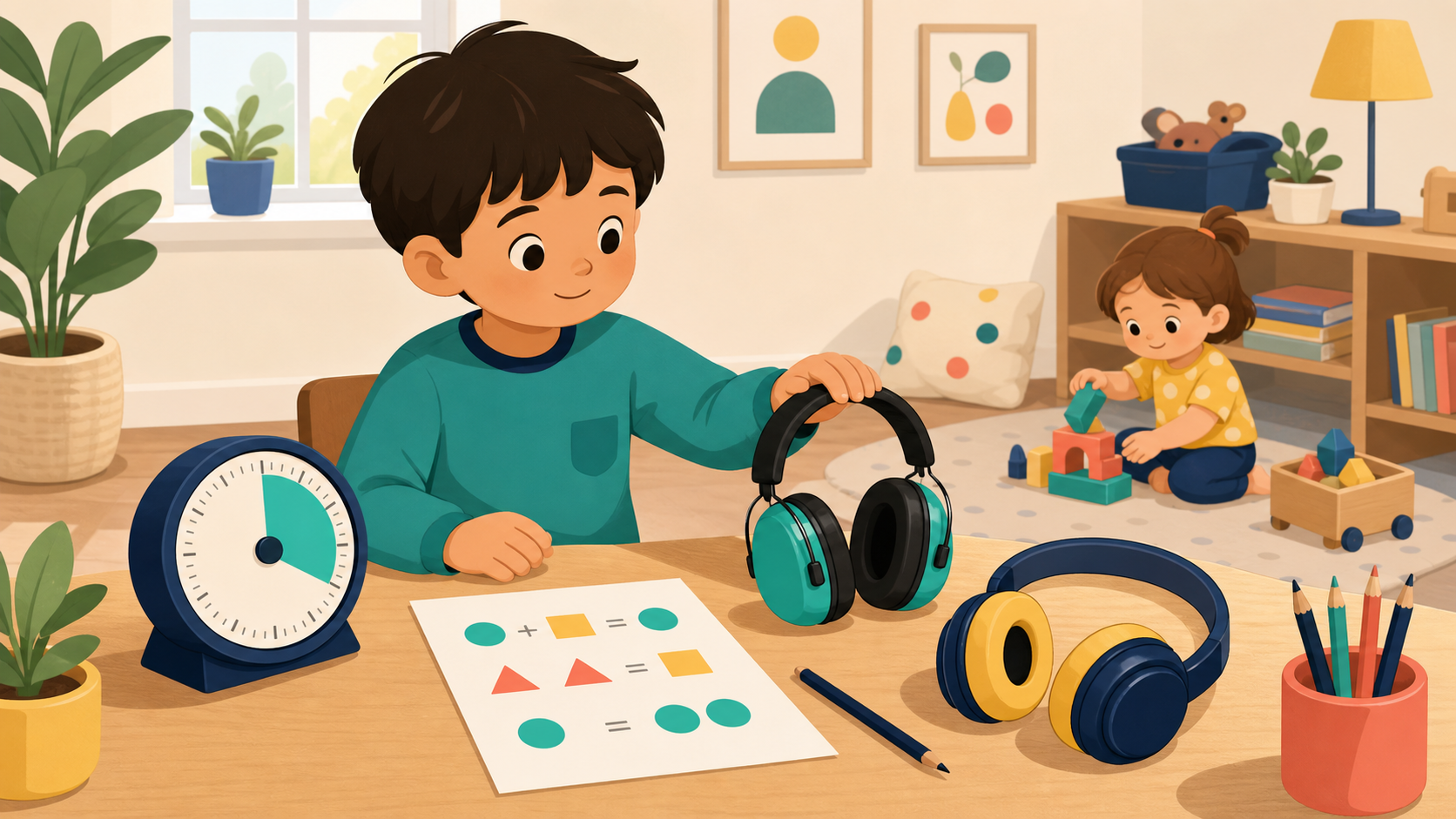
“We are going to focus on math for five minutes. The timer will show us when five minutes is done. Then we can stop and go outside.”
That is a very different nervous system message.
The child can see the end.
The parent is not moving the finish line.
The sibling is still distracting, but the focus window is small enough to try.
The script I would use
I would keep it warm and concrete:
“I know it’s harder when little sister is playing nearby.”
“Your focus is like a muscle.”
“We can make it stronger with a tiny practice.”
“Today we’re only going to try math for five minutes.”
“The timer will show us when five minutes is up.”
“Then we’ll stop and go play outside.”
That script does a few important things.
It validates the distraction.
It frames focus as a skill, not a character flaw.
It keeps the practice short.
It gives a clear next thing.
And it lets the timer carry part of the boundary.

Add one sensory support if noise is the trigger
If the sibling noise is the biggest problem, the timer may not be enough by itself.
Some kids need the environment turned down before the work can begin.
That might look like:
- soft earmuffs
- child-safe headphones
- quiet background music
- moving the work table slightly away from the play area
- giving the younger sibling a special “busy basket”
The goal is not silence.
The goal is less friction.
You are not trying to create a perfect homeschool classroom.
You are trying to make five minutes possible.
What to do when the timer ends
This part matters.
When the timer ends, stop.
Even if the page is not finished.
Especially at the beginning.
If you say “five minutes” and then add “just finish these three more,” the timer stops feeling trustworthy.
The child learns:
The timer does not really mean done.
The adult can still add more.
So for the first few days, let five minutes be five minutes.
You can always do another five-minute block later.
But the first goal is not math volume.
The first goal is:
My child can focus for a short visible window and survive the feeling of effort.
That is a real win.
Try one five-minute focus block.
Duckie turns “just focus for a bit” into something your child can actually see, so the work has a clear beginning and end.
A simple first-week plan
Try this for one week:
Day 1-2:
Five minutes only. Stop when the timer ends.
Day 3-4:
Five minutes, short break, then decide together if another short block feels possible.
Day 5-7:
Add one tiny goal inside the timer: “finish two problems,” “read the first row,” or “circle what feels tricky.”
Keep the next step predictable:
Math -> timer done -> outside / snack / movement break.
The next step does not have to be fancy.
It just needs to be clear.
What if five minutes is still too much?
Make it smaller.
Try two minutes.
Try one problem.
Try “look at the page and circle the easy one.”
Try math at a different time of day.
Try headphones first, then timer.
Shorter does not mean failure.
Shorter means you found the current starting line.
And once the starting line is honest, progress becomes much easier to build.
The point is not perfect focus
A 5-year-old is not supposed to focus like a 10-year-old.
And a child with a noisy sibling nearby is not failing because they notice the noise.
The real goal is not silent, perfect concentration.
The real goal is helping the child learn:
I can try for a little while.
I can see when it ends.
I can do hard things in small pieces.
That is the muscle.
And five visible minutes is a very good place to start.
Make focus practice visible.
Use Duckie for short math, reading, cleanup, or waiting blocks when “just focus” feels too abstract.