 KidCue
Updated 2026-10-24
Autistic Scripting and School Meltdowns: Make Corrections Safer
When correction triggers scripting, shame, or school meltdowns, use private prompts, visual redo steps, and a planned reset path to make feedback safer.
这篇文章尚未完成中文翻译,以下正文为英文原文。
You correct a math problem, the child hears “wrong,” and the same loop begins: repeated scripts, “I’m a monster,” stomping, or screaming. At school it can disrupt the morning. At home it may appear after a demanding day.
That response is not proof of defiance. Correction may be arriving as social threat at the exact moment flexible language becomes harder to access.
The following ideas are supports families can discuss with the child’s school team. They are not a substitute for an individualized evaluation or education plan.
Make corrections private, predictable, and visual
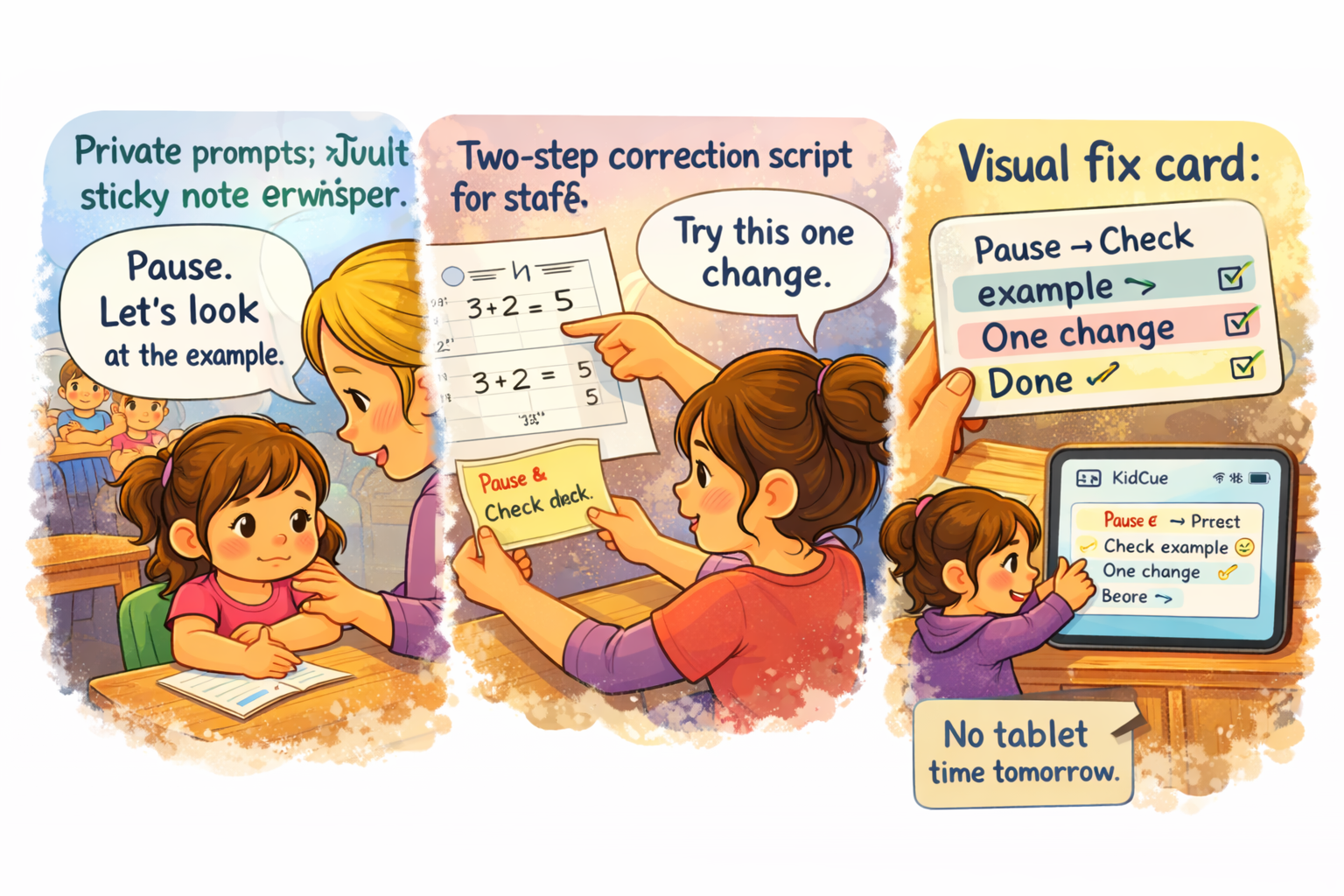
- Private prompts: Use a quiet sticky note or whisper instead of a public “No, that’s wrong.” This reduces the social pressure around correction.
- Two-step correction script for staff:
- “Pause. Let’s look at the example.” (no “wrong”)
- “Try this one change.” (one micro-step)
- Visual fix card: A small card that says “Pause → Check example → One change → Done.” The child can point to it instead of processing more spoken language. Add it to KidCue as a mini-sequence that can be rehearsed before class.
Build a visible day—reduce surprise alarms
- Morning visual schedule + timer: Show “wake → dress → breakfast → bus → calm-corner check-in.” Use a visual timer for the two hardest transitions, such as getting dressed or leaving.
- Class block strip: On the desk: “Warm-up → Math → Movement → Reading → Lunch → Recess → Art → Home.” When an unexpected assembly appears, staff can swap one card so the change is visible instead of only verbal.
Give a regulated exit, not an escape route
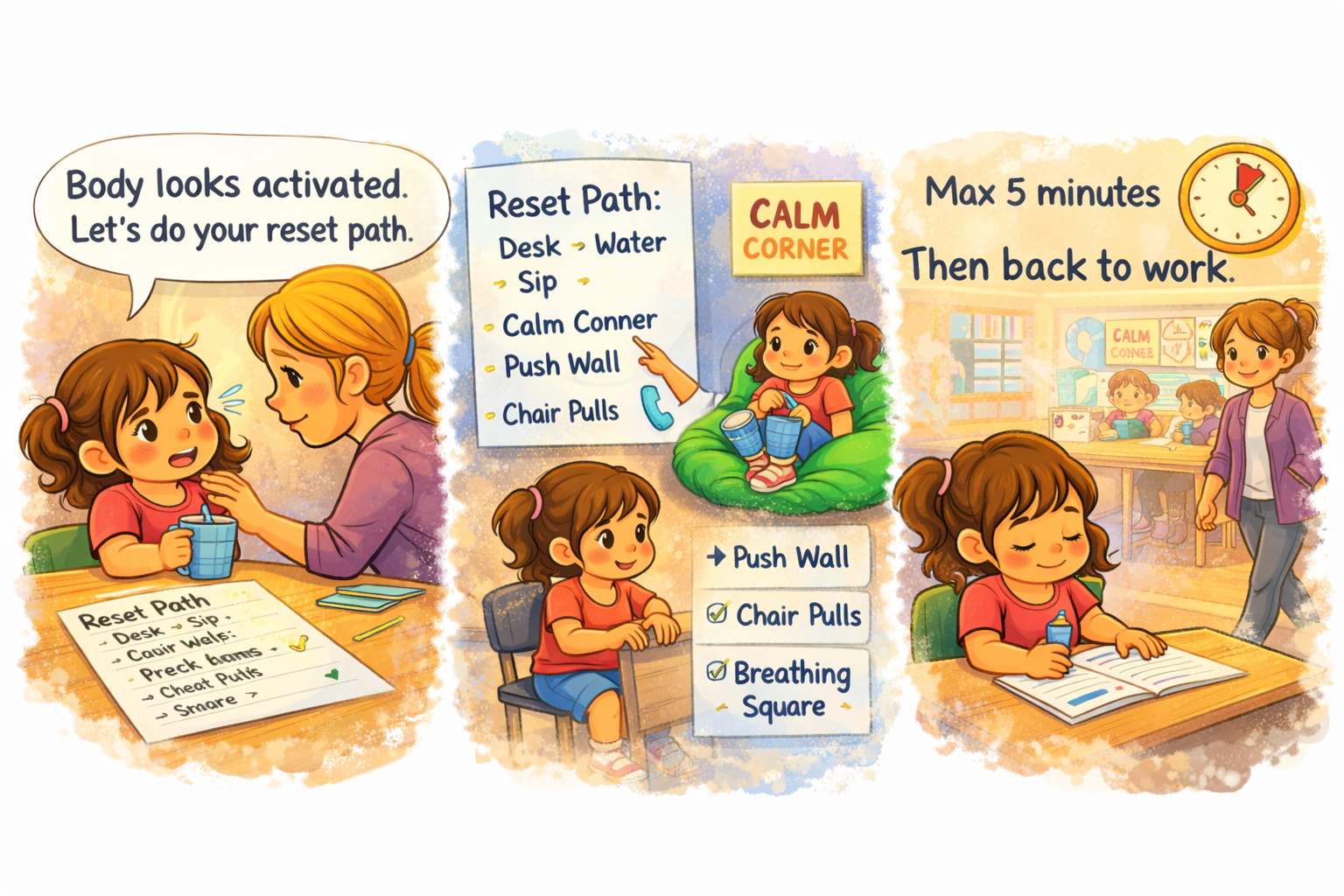
- Pre-agreed “reset path”: Desk → water sip → calm corner → an agreed regulation option. The timing and return plan should be decided with the child’s support team, not improvised during distress.
- One adult, few words: The adult uses the same 2-sentence script: “Body looks activated. Let’s do your reset path.” No questions, no “why.”
Language that lowers threat
- Swap “no/stop” with redirect + do language: “Start with step 1,” “Use your example line,” “Hands on the desk.”
- Label state, not identity: “Your body feels loud,” instead of “You’re being bad.”
- After calm, short debrief: “What helped you get back?” under 20 seconds, not a 10-minute post-mortem.
Home decompression that actually generalizes
- Arrival script: Use a predictable decompression block before homework talk, based on activities the child already finds regulating.
- “Monster” scripting response: “Sounds like your brain is yelling. Let’s give it a job—pick a reset card.” (Hands her the visual choices instead of asking why.)
- AAC backup: If speech locks, she points to “I need break / water / squeeze” on a tiny paper or device—same icons she uses at school.
IEP asks that moved the needle
- Ask whether a Functional Behavior Assessment (FBA) is appropriate when correction-triggered distress repeatedly blocks learning.
- If the team uses a behavior support plan, request that it document the private correction protocol, reset path, visual desk strip, and how adults will support return to learning.
- Morning priming: staff meets her at door with the day’s visual strip and first success task ready.
- Data on antecedent → response → recovery time to see which corrections spike her.
Questions for the child’s support team
- What usually happens immediately before the scripting or distress?
- Can corrections be private, shorter, and paired with one visible redo step?
- Does the child have a reliable non-speaking way to request help, a break, or clarification?
- Is the task accessible at the child’s current skill and regulation level?
- Are home and school using the same short language for the reset path?
Treatment, therapy, AAC, sensory supports, and medication decisions should be made with qualified professionals who know the child. The goal here is not to prescribe an intervention; it is to make the questions and routines easier to discuss.
Morning buffer to reduce AM explosions
- Brief preview: show the day strip and mark any changed blocks.
- One guaranteed win before leaving (easy puzzle, short drawing) so she banks success chemicals.
- Leave enough buffer for a calm arrival and use only movement or sensory strategies already agreed with the child and support team.
If the screaming loops keep growing
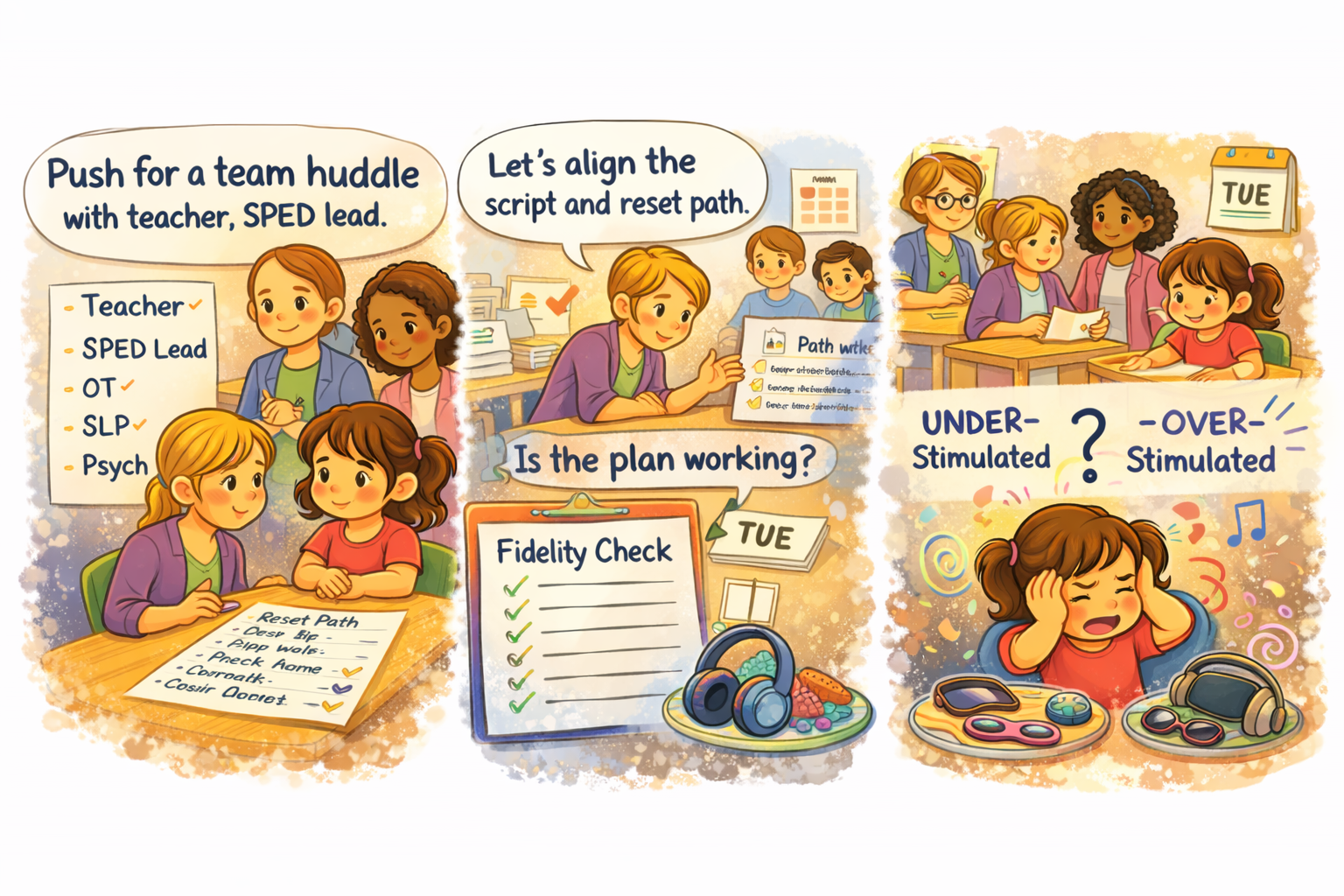
- Push for a team huddle with teacher, SPED lead, OT, SLP, and psych; align the single correction script and reset path.
- Ask for fidelity checks (is everyone using the script?) before adding new interventions.
- Consider a sensory diet review—if she’s under/over-stimulated, corrections hit harder.
What progress may look like
Progress is not a fixed week-by-week timeline. Look for smaller signs:
- the child accepts a private prompt more often
- the reset path is used earlier
- recovery takes less support
- the child returns without a long post-mortem
- staff use the same correction language consistently
Track patterns without promising a deadline. If distress grows, safety is affected, or the child begins using more self-critical language, bring the team together and reassess the plan.
If a child crumples into “I’m a monster,” make the correction safer: quiet, visual, one-step redo, and a clear way back to calm. The more visible and rehearsed the routine, the less uncertainty surrounds the mistake. Use KidCue to build a morning strip, desk strip, or reset sequence, then rehearse it when everyone is regulated.
相关专题聚合
如果这篇内容对你有帮助,建议继续看这些专题页。