 KidCue
2026-06-23
For Kids Who Struggle With Transitions, Predictable Beats Exciting
When kids struggle with transitions, a predictable day, visual schedule, and calm warning can help the next step feel knowable instead of sudden.
Sometimes the most helpful thing an adult brings into the room is not a new strategy.
It is calm.
Not fake calm.
Not “everything is fine” calm.
The kind of calm that says:
I know what comes next.
I am not surprised by this hard moment.
The day still has a shape.
For kids who struggle with transitions, that matters.
A lot.
Because many hard moments are not really about the exact activity.
They are about uncertainty.
What is happening now?
How long will it last?
What happens after this?
Are the rules changing again?
When the day feels unpredictable, a child has to spend extra energy just figuring out where they are inside it.
That can look like refusal.
It can look like arguing.
It can look like running away from the table, crying before the next task, or asking the same question again and again.
But underneath, the child may simply be trying to find the edge of the moment.

Predictable does not mean rigid
Predictable does not mean every minute is controlled.
It does not mean childhood has to feel strict.
It means the child can understand the basic rhythm:
First this.
Then that.
When this is done, we move there.
When the timer finishes, the next thing starts.
That rhythm can be boring to adults.
But boring and consistent is often exactly what helps kids settle.
Exciting and unpredictable may look fun from the outside, but for a child who has a hard time shifting gears, it can feel like the floor keeps moving.
Same routine.
Same words.
Same visual cue.
Same transition warning.
That repetition is not laziness.
It is support.
Make the day visible before you ask for flexibility
Adults usually carry the schedule in their heads.
Kids do not.
So we say:
“After this, we’re going to clean up.”
“Soon we need to leave.”
“Almost time for math.”
“Just a few more minutes.”
Those words may be clear to us.
But to a young child, especially a child who struggles with transitions, “soon” can feel like a trap door.
Suddenly, the current thing is gone.
Suddenly, the next demand is here.
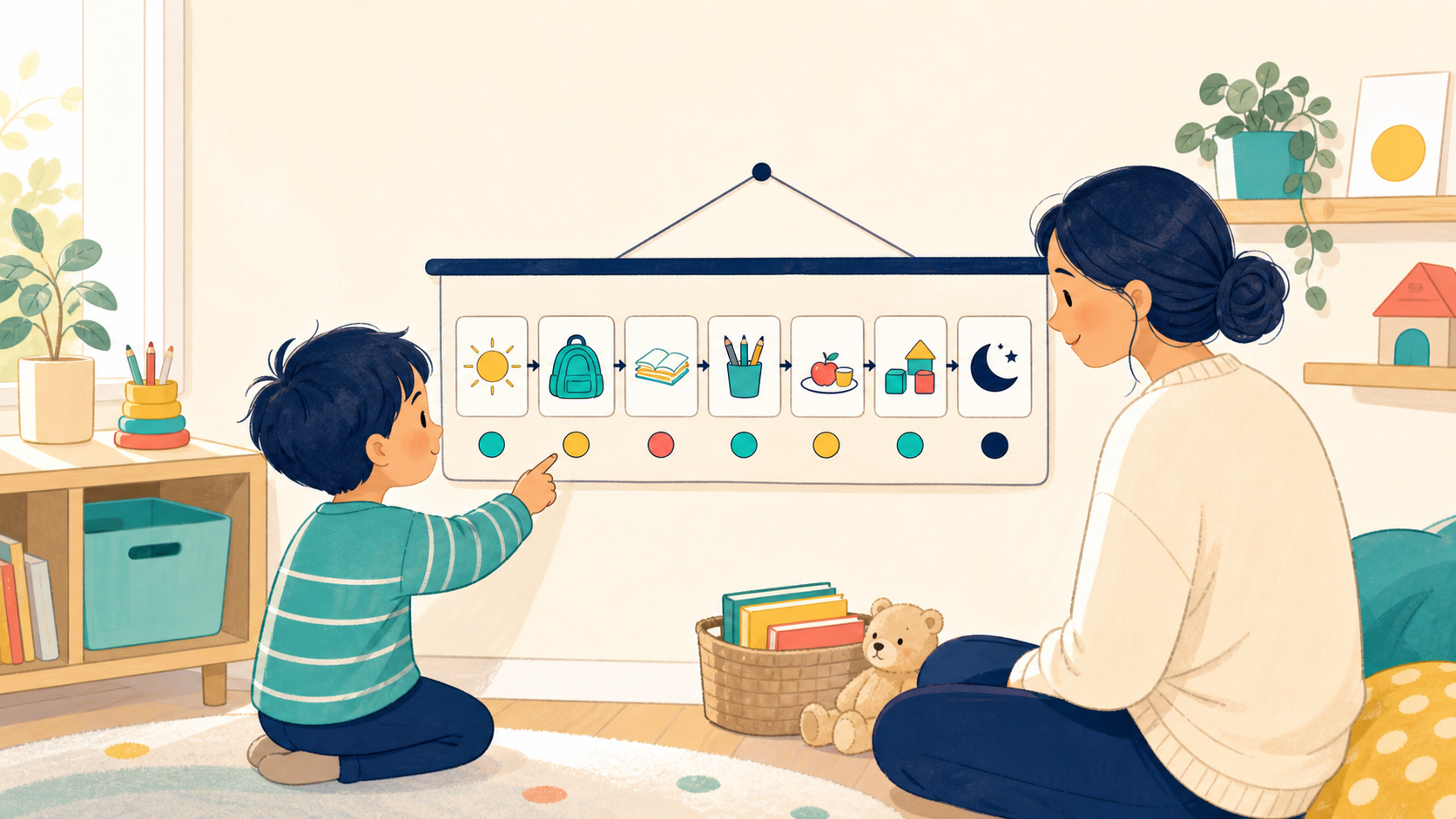
A visual schedule gives the day a visible map.
It can show:
- what is happening now
- what comes next
- what is already finished
- when a break is coming
- where the hard part sits inside the day
The schedule does not need to be fancy.
In fact, the simpler it is, the more likely adults will keep using it.
And the system you actually keep using is usually better than the perfect one you abandon by Thursday.
Transition warnings work better when kids can see them
A verbal warning helps.
A visible warning helps more.
If a child is playing, reading, watching a short video, doing a preferred task, or sitting in a calm corner, a sudden stop can feel like the adult took the moment away.
But when the ending is visible, the stop is less sudden.
You can say:
“Five more minutes, then cleanup.”
“The timer will show when play is finished.”
“When the green is gone, we move to the table.”
“Now play. Next shoes.”
The point is not to remove every feeling.
Kids may still protest.
They may still need help.
But the transition is no longer invisible.
The child can see it coming.
Your calm carries the routine
A visual schedule can help.
A timer can help.
A now-next board can help.
But the adult’s nervous system still matters.
If the adult sounds surprised every time the child struggles, the moment gets bigger.
If the adult starts negotiating, explaining, repeating, pleading, and changing the plan, the routine becomes harder to trust.
Calm does not mean permissive.
It means steady.
The script can be short:
“I know stopping is hard.”
“The timer is done.”
“Now cleanup.”
“Then snack.”
That is enough.
Not because the child instantly loves it.
But because the adult is making the day knowable.
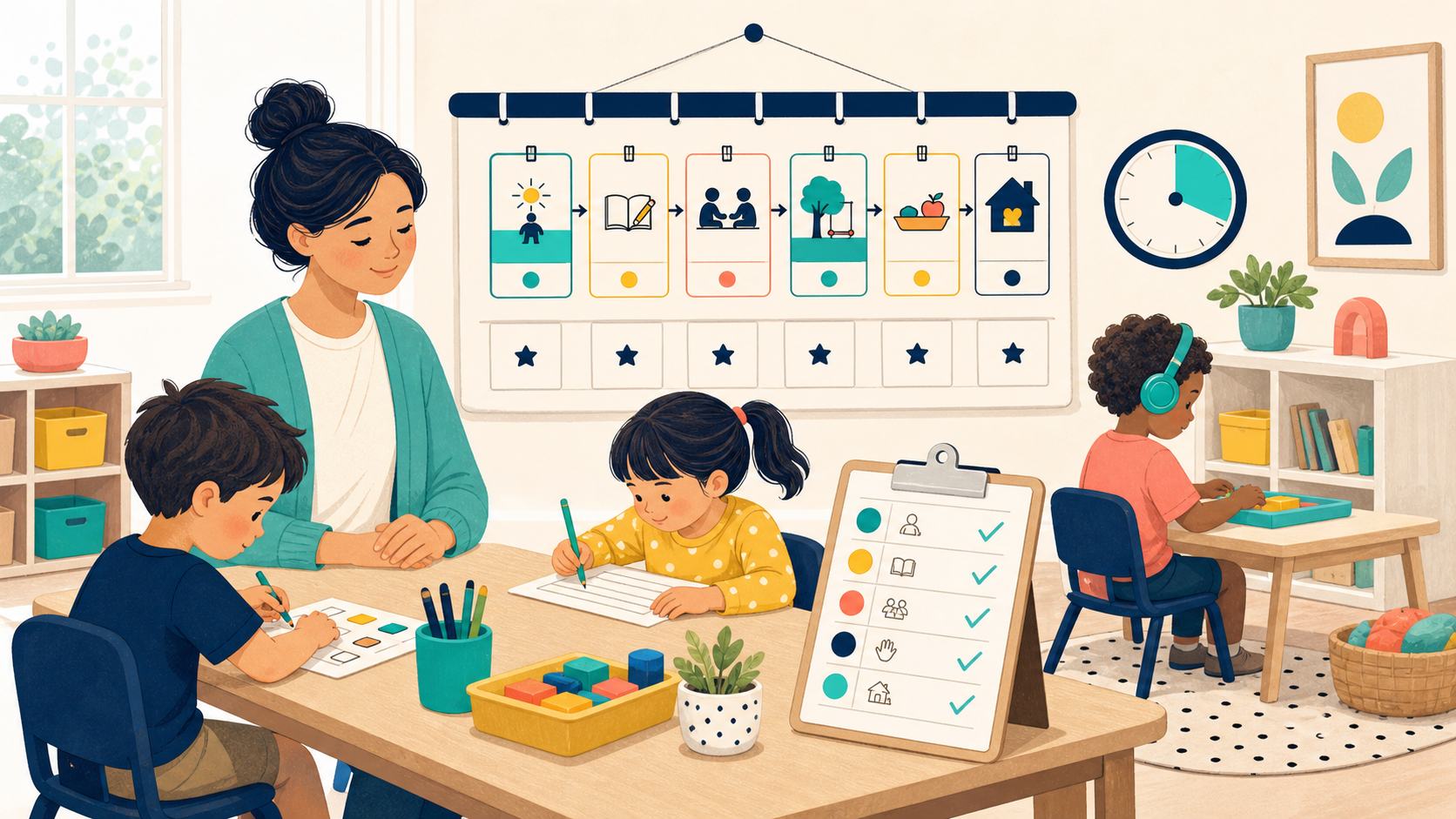
For classrooms: keep the system simple enough to survive the day
In special education classrooms, predictable routines matter even more.
But complicated systems can collapse fast.
If the visual schedule takes too long to update, it will not get updated.
If data collection requires a separate mental tab all day, it may not happen consistently.
If grouping is based on what is convenient instead of what goals actually require, the day can start to drift.
The best system is usually the simplest one that still answers the real questions:
- What does this child need to practice?
- When will we practice it?
- How will the adult know it happened?
- Where does that practice fit naturally in the routine?
This is not about making the room look organized.
It is about making support repeatable.
For home: start with one hard transition
You do not have to rebuild the whole day.
Start with one transition that keeps going sideways.
Maybe it is:
- leaving the house
- turning off a show
- starting homework
- brushing teeth
- coming to dinner
- moving from play to cleanup
- getting ready for bed
Pick one.
Then make that transition boring and visible.
Use the same short script each time.
Use the same timer.
Show the same next step.
For example:
“Five minutes of play, then shoes.”
“One show, then snack.”
“Timer first, then cleanup.”
“Now blocks. Next bath.”
The goal is not a perfect transition.
The goal is a less surprising one.
Make one transition visible today.
Duckie helps turn “soon” and “almost done” into a simple visual timer and next-step cue your child can actually see.
What if the child still melts down?
Then the child still needs support.
That does not mean the visual schedule failed.
It may mean the transition was too big, too fast, too noisy, too late in the day, or too hard to understand yet.
Try making the support smaller and clearer:
- shorten the countdown
- show only now and next
- reduce the number of words
- practice the transition when everyone is calm
- keep the next step easier for a few days
- add a small regulating step before the demand
And if your child has an IEP, therapy plan, behavior support plan, or school team, keep following that guidance.
A visual schedule is not a replacement for individualized support.
It is one practical way to make daily expectations easier to understand.
The day does not need to be exciting to be good
Sometimes adults feel pressure to make every routine engaging.
More novelty.
More choices.
More fun.
But for many kids, especially kids who struggle with transitions, the gift is not more excitement.
The gift is knowing.
Knowing what comes next.
Knowing the adult will stay steady.
Knowing the ending will be visible.
Knowing the routine will be the same tomorrow.
That kind of boring can be deeply kind.
Because when the day is knowable, the child does not have to spend all their energy guessing.
They can settle.
They can participate.
They can practice the next small step.
And the adult does not have to carry the whole day with words.
The routine helps carry it too.
Try Duckie for a predictable transition.
Use a visual timer, a simple routine, and a clear next step so the day feels less sudden for your child.
Related Topic Hubs
If this post helped, these curated hub pages can guide your next steps.